






Date
15 April 2026Updated
05 May 2026
11 min read

When Does Short-Term Absence Become Long-Term Absence?
There's no fixed legal definition of long-term sickness absence. No statute tells you that four weeks is the magic number. In practice, most employers and HR professionals treat absence as long-term once it has lasted, or is expected to last, four weeks or more — though some organisations set the threshold at two or three weeks for higher-risk roles. The threshold you choose matters less than applying it consistently.
What the law cares about is not the label you attach to the absence, but how you respond to it. An employee off sick for six weeks is in a fundamentally different situation from one who has had six one-day absences. Manage them the same way and you're asking for trouble — one may be a malingerer, the other could be seriously ill.
Practical Thresholds for Absence
A reasonable working approach for most SMEs is to treat absence as long-term when it reaches the four-week point, or earlier if the employee has provided medical evidence suggesting an extended prognosis — for example a fit note covering eight weeks for a surgical procedure. Either way, by week four you should have:
• Made welfare contact with the employee at least once
• Received and filed any fit notes (formerly 'sick notes') provided by their GP
• Considered whether an occupational health referral is appropriate
• Checked whether the absence might engage the Equality Act 2010
Absence Triggers for Formal Management
Welfare contact is informal. Formal management is something different. You move into formal territory when you need to hold a capability meeting, consider medical dismissal, or make decisions about pay or contractual obligations. Common triggers include:
• Statutory Sick Pay (SSP) running out at 28 weeks
• Occupational health reporting that a return within a reasonable timeframe is unlikely
• The absence affecting operational capacity — you need the role filled
• The employee's own medical evidence pointing to a prolonged or permanent condition
Key Point
The clock for 'long-term' starts from the first day of the continuous absence, not from the date you first get concerned about it. Keep accurate records from day one — they'll be essential if you end up at a tribunal.
Statutory Sick Pay — The New Rules from April 2026
The Employment Rights Act 2025 made two significant changes to SSP, both in force from April 2026. If you're still operating under the old rules, you're already non-compliant.
The Lower Earnings Limit Is Gone
Previously, employees had to earn at least the lower earnings limit (£123 per week in 2024/25) to qualify for SSP. That threshold has been abolished. From April 2026, all employees are entitled to SSP from day one of employment, regardless of their earnings. This particularly affects part-time workers and those on variable hours — many of whom previously had no entitlement at all.
The Three Waiting Days Are Gone
Under the old regime, SSP didn't kick in until the fourth qualifying day of sickness — the first three days were 'waiting days' for which nothing was due. That rule has been removed. SSP is now payable from the first qualifying day of sickness. For employees with irregular hours or those who are frequently absent, this changes your cost exposure meaningfully.
The Rate and the 28-Week Limit
The standard SSP rate for 2026/27 is £118.75 per week (verify the current rate on GOV.UK, as it is uprated annually in April). It is payable for a maximum of 28 weeks in any period of incapacity for work.
Once 28 weeks' SSP has been exhausted, you have no further statutory obligation to pay — though your own contractual sick pay scheme may be more generous.
SSP AT A GLANCE — APRIL 2026 ONWARDS
• Qualifying employees: ALL employees, regardless of earnings
• Waiting days: NONE — SSP runs from the first qualifying day of sickness
• Current weekly rate: £118.75 (check GOV.UK for annual uprating's)
• Maximum duration: 28 weeks in a period of incapacity
• Qualifying days: days the employee would normally work
One practical point worth flagging: if your absence policy or employment contracts still reference the old SSP rules — for instance, stating that SSP applies from day four — those clauses are now less favourable than the statutory minimum and the statutory minimum prevails. Update your documentation.
Occupational Health Referrals for Absence
An occupational health (OH) referral is one of the most useful tools available to an employer managing long-term sickness — and one of the most underused. A GP fit note tells you why an employee can't work. An OH report tells you what adjustments might enable them to return, how long recovery is likely to take, and whether the underlying condition might constitute a disability under the Equality Act. That's much more actionable information.
When to Refer a Staff Member to Occupational Health
There's no rule saying you must refer, but doing so before making any capability decision is almost always sensible. Best practice is to refer:
• After four weeks of continuous absence, as a matter of routine
• Earlier if the employee's condition is complex or the prognosis is unclear
• Whenever you're considering a phased return, adjusted duties, or reasonable adjustments
• Before any formal capability meeting where ill-health dismissal might be on the table
What to Ask in an Occupational Health Referral?
The quality of an OH report is largely determined by the quality of your referral questions. A vague referral produces a vague report. Be specific. Standard questions worth including are:
• What is the likely prognosis and anticipated return-to-work date?
• Is the employee fit for any work, and if so, under what conditions?
• Are there any adjustments that would facilitate an earlier or sustained return?
• Is the condition likely to be a disability as defined by the Equality Act 2010?
• Is the employee well enough to attend a meeting with management?
Using an Occupational Health Report — and the Employee's Right to See It
Before referring, you need the employee's written consent. The Access to Medical Reports Act 1988 gives employees the right to see any medical report prepared by their own doctor for employment purposes before it is sent to you. OH reports from independent practitioners are not technically within the Act, but good practice — and common OH provider practice — is to share the report with the employee anyway. An employee who trusts the process is more likely to engage with it.
Once you have the report, use it. Don't file it away and proceed as if it doesn't exist. If a tribunal later asks why you dismissed an employee for ill health, 'we obtained an OH report but didn't really take it into account' is not a reassuring answer.
Disability Considerations for Absence Under the Equality Act 2010
This is where long-term sickness management gets significantly more complex. If an employee's condition qualifies as a disability under the Equality Act 2010, the rules change. Dismissing a disabled employee without going through the right process — or without having considered reasonable adjustments — is likely to be both unfair dismissal and disability discrimination. The compensation for disability discrimination is uncapped.
When Does Sickness Become a Disability?
Under section 6 of the Equality Act 2010, a person has a disability if they have a physical or mental impairment that has a substantial and long-term adverse effect on their ability to carry out normal day-to-day activities. Unpacking that definition:
Substantial: more than minor or trivial. A bad back that prevents someone sitting at a desk for more than an hour is likely to qualify.
Long-term: has lasted, or is likely to last, at least 12 months — or is likely to last for the rest of the person's life. Crucially, the 12 months can be anticipated from the outset; you don't have to wait for 12 months to pass before the duty arises.
Day-to-day activities: interpreted broadly — walking, concentrating, maintaining social relationships, managing emotions.
Disability Discrimination Risk in Absence Management
• You don't need a formal diagnosis of disability to be bound by the duty to make reasonable
adjustments. If you know — or ought to know — that an employee may be disabled, the duty arises.
Ignorance is rarely a defence if the facts were obvious.
• Cancer, HIV, and multiple sclerosis are deemed disabilities from the point of diagnosis, regardless of the 12-month test.
The Duty to Make Reasonable Adjustments
Section 20 of the Equality Act imposes a duty on employers to make reasonable adjustments where a provision, criterion, or practice (PCP) puts a disabled employee at a substantial disadvantage compared with non-disabled employees. In a sickness context, your absence management policy is a classic PCP. If it treats everyone the same regardless of disability, it may be unlawful.
What counts as 'reasonable' is fact-specific. Factors include the size of your business, the cost of the adjustment, the operational disruption, and the likely benefit to the employee. Common adjustments in long-term sickness situations include:
• Phased return to work — starting with reduced hours and building up gradually
• Adjusted duties — removing tasks the employee cannot currently perform
• Different working hours — avoiding early starts or peak commute times
• Working from home for part or all of the working week
• Providing specialist equipment — ergonomic furniture, screen readers
• Allowing additional time off for medical appointments
A phased return isn't simply a goodwill gesture — for disabled employees it can be a legal requirement.
Get OH advice on what a sensible phased return looks like, put it in writing, and review it regularly.
Fair Dismissal for Ill Health - Getting the Process Right
Dismissing someone because they are too ill to work is a capability dismissal not a misconduct dismissal. That distinction matters enormously. The employee hasn't done anything wrong. They're ill. The question the tribunal asks isn't 'did the employee deserve to be dismissed?' but 'did the employer act reasonably in treating the illness as sufficient reason to dismiss?'
Capability, Not Misconduct
Capability dismissals are fair under section 98 of the Employment Rights Act 1996 where the reason relates to the employee's capability as assessed by reference to health. The statutory test in section 98(4) is whether the employer acted reasonably in treating that reason as sufficient to dismiss, having regard to equity and the substantial merits of the case. That's a broad test — deliberately so.
The Process - Step by Step
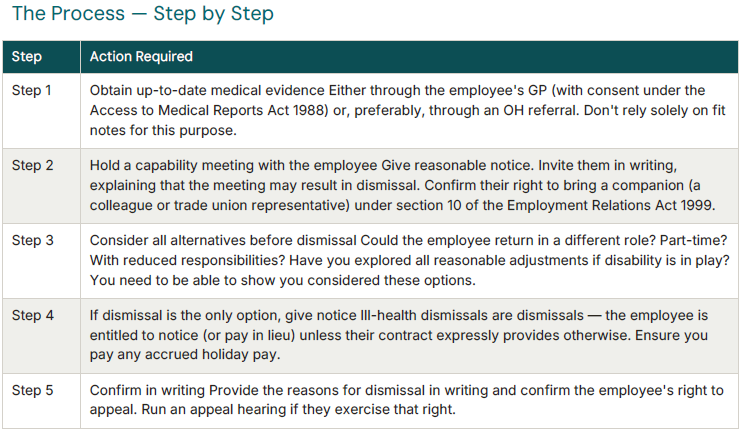
At What Point Can You Dismiss an Employee Regarding Absence?
There's no bright-line rule on when you can dismiss. Tribunals look at all the circumstances — the size and resources of your business, the nature of the role, the likely prognosis, whether alternatives have been tried. A tribunal is less sympathetic to a large organisation that dismissed after eight weeks without exploring reasonable adjustments, and more sympathetic to a small business that waited six months, obtained two rounds of OH advice, and had no realistic prospect of the employee returning.
Watch Out for Disability Discrimination
If the employee's condition meets the Equality Act definition of disability, a fair capability dismissal process is necessary but not sufficient. You also need to show you made all reasonable adjustments before concluding dismissal was justified. Skipping adjustments and proceeding straight to dismissal risks an uncapped discrimination award on top of any unfair dismissal claim.
Key Case Law — The East Lindsey Approach
Employment tribunal decisions on ill-health dismissal draw heavily on principles set out in the
Employment Appeal Tribunal's decision in East Lindsey District Council v Daubney [1977] IRLR 181. Though the case is nearly fifty years old, its framework remains the standard against which capability dismissals are measured.
The EAT held that before dismissing for ill health, an employer must:
1. Consult the employee. Not just inform them — genuinely consult. The employee should be given the opportunity to put their view, share their own medical evidence, and explain their situation before any decision is reached.
2. Obtain proper medical evidence. The employer must make reasonable efforts to find out the true medical position. Relying purely on absence records — without medical investigation — is not enough.
3. Consider all alternatives. Could the employee return to a different role, reduced hours, or adjusted duties? Alternatives must be genuinely considered, not dismissed on a cursory basis.
4. Then make a balanced decision. Taking all of the above into account, the employer must reach a reasonable conclusion about whether continued employment is viable. If dismissal is decided upon, the process must be followed through correctly.
Later cases have refined — but not replaced — this framework. In Lynock v Cereal Packaging Ltd [1988] IRLR 510, the EAT emphasised the importance of sympathy and compassion in the process, stressing that ill-health dismissal is 'a situation calling for the greatest of care'. That's not just good employment law — it's good management.
THE EAST LINDSEY CHECKLIST
• Have you consulted the employee — not just notified them?
• Do you have medical evidence (OH report or GP report) addressing the prognosis?
• Have you genuinely considered alternative roles, hours, or adjustments?
• Have you taken all of this into account before reaching a decision?
• Have you confirmed the decision in writing with reasons and appeal rights?
Mental Health and Work-Related Stress Absence
Mental health conditions — depression, anxiety, PTSD — now account for a substantial proportion of long-term sickness absences in the UK. Managing them effectively requires a slightly different approach to physical illness, not because the legal framework differs (it doesn't materially), but because the factors driving absence often involve the workplace itself.
The Employer's Duty of Care
Under the Health and Safety at Work etc. Act 1974, employers have a duty to protect employees' health, safety, and welfare — and that expressly includes mental health. The leading case of Hatton v Sutherland [2002] EWCA Civ 76 established that liability for psychiatric injury caused by work-related stress depends on foreseeability. If the signs of stress were apparent — if the employee told their manager they were struggling, or the workload was objectively unmanageable — and the employer did nothing, liability can follow.
Stress Risk Assessments
The Health and Safety Executive (HSE) publishes Management Standards for work-related stress, covering six areas: demands, control, support, relationships, role, and change. Carrying out a stress risk assessment isn't a bureaucratic exercise — it's a genuine tool for identifying where someone's stress is coming from and whether it originates in the workplace.
Where an employee is off sick with stress and the cause is at least partly work-related, you have an even stronger reason to investigate and address it before expecting them to return. Simply demanding a return to the same role, with the same pressures, is unlikely to produce a sustained recovery — and may give rise to a personal injury claim if it leads to a relapse.
Mental Health and Disability
Mental health conditions can qualify as disabilities under the Equality Act 2010 just as readily as physical conditions. Depression that has lasted or is likely to last 12 months and substantially affects daily activities — including the ability to concentrate, sleep, or leave the house — will meet the test. That triggers the reasonable adjustments duty.
MENTAL HEALTH — PARTICULAR RISKS
• If the employee's mental health condition was caused or worsened by the way they were managed — excessive workload, a difficult line manager, bullying — you face potential personal injury liability in addition to unfair dismissal or discrimination claims.
• Keep a genuine open-door policy during the absence. Regular, proportionate welfare contact can prevent a modest anxiety condition from developing into a prolonged breakdown — but over-contact can make things worse. Follow OH advice.
Practical Tips for Managing Long-Term Absence
The legal framework is only half the story. How you manage long-term absence day-to-day has a big impact on outcomes — for the employee, for your team, and for your business. Here are the most important practical measures.
Have a Written Absence Management Policy
If you don't have one, write one. A good absence management policy should cover how absences are reported, when fit notes are required, what 'welfare contact' means in practice, how trigger points work (for short-term absence — covered separately), and the process for managing long-term absence. Crucially, it should state clearly that disabled employees may be treated differently from the standard process, and that reasonable adjustments will be considered.
Return-to-Work Interviews
Return-to-work interviews are one of the most effective tools for managing absence. They're most often associated with short-term intermittent absence, but they matter for long-term absence too. After any significant absence, a structured conversation between the employee and their manager — covering how they're feeling, whether any adjustments are needed, and what support is available — makes a difference. It also demonstrates that you took the return seriously, which matters if things later go wrong.
Keeping in Contact During Absence
The default for many managers is to leave an absent employee entirely alone, for fear of being seen to put pressure on them. That's understandable, but it's not the right approach. Reasonable, proportionate contact during absence is not harassment — it's good management. It maintains the employment relationship, ensures the employee doesn't feel abandoned, and gives you information you need.
What 'proportionate' means will vary. Fortnightly welfare calls — not work calls — are generally appropriate for most long-term absences. More frequent contact may be needed if a return is imminent.
Contact should be supportive, not interrogative. And get OH advice if you're unsure how often to make contact, particularly where mental health is involved.
Trigger Points for Absence - Using Them Sensibly
Many absence policies use trigger points — specific absence thresholds that automatically initiate a formal review. Common examples include the Bradford Factor for short-term absence, or a calendar-based trigger (e.g., any absence exceeding 12 weeks moves into formal management). These are useful because they depersonalise the process — the trigger fires automatically, regardless of who the employee is or how well-liked they are.
The risk is rigid application. If your trigger points apply equally to a disabled employee whose absences are entirely disability-related, you may have a discrimination claim on your hands. Policies should state that trigger points may be disapplied or adjusted for disabled employees, and that each case will be considered individually.
Quick Absence Timeline Guide
| Timescale | Key Actions |
| Week 1- 4 | Self-certification / fit notes Welfare contact begins Record all absences accurately |
| Week 4+ | Consider OH referral Confirm whether Equality Act may apply Begin formal absence management if needed |
| Week 8-12 | Review OH report Hold capability discussion with employee Consider reasonable adjustments |
| Week 20+ | Reassess prognosis Consider alternatives to the current role Prepare for possible dismissal process |
| Week 28 | SSP exhausts If no return is realistic, formal dismissal process may be appropriate Confirm in writing with appeal rights |
Before You Dismiss Someone for Absence - Final Checklist
• Have you obtained current medical evidence from OH or the employee's own doctor?
• Have you consulted the employee and given them a genuine opportunity to respond?
• Have you considered all reasonable alternatives, including adjusted duties, reduced hours, or
redeployment?
• If the employee may be disabled, have you made all reasonable adjustments?
• Have you given proper notice (or PILON) and confirmed the dismissal in writing with appeal rights?
Need Legal Help With Managing Absence?

Next Steps
For long-term absence issues, → consider flexible working options
If illness leads to dismissal, → review the disciplinary process
If disputes arise, → see employment tribunal guidance
Also Check out our top tips for Managing Absence: