






Date
15 April 2026Updated
05 May 2026
13 min read

Current National Minimum Wage Rates from April 2026
Every April, the National Minimum Wage rates change — and April 2026 brings increases across every band. If your payroll hasn't been updated to reflect the new rates, you're already in breach. It doesn't matter that you paid correctly last year. HMRC doesn't give credit for past compliance.
The headline figure is the National Living Wage (NLW), which since April 2021 has applied to workers aged 21 and over. From April 2026, that rate rises to £12.71 per hour. But the full picture is more nuanced — there are separate rates for younger workers and apprentices, and getting those wrong is just as much a breach as underpaying an adult worker.
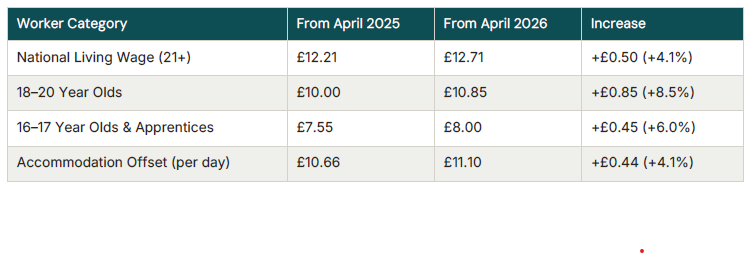 Source: Low Pay Commission recommendations accepted by the government for April 2026. Check
gov.uk/national-minimum-wage-rates for the latest rates.
The Accommodation Offset - Often Overlooked for National Minimum Wage
If you provide accommodation to a worker, you're allowed to offset its value against the NMW — but only up to the daily rate of £11.10. Above that threshold, any accommodation charge reduces the worker's effective pay for NMW purposes. Employers in hospitality, agriculture, and care who house their staff often fall into the trap of charging market-rate rents that inadvertently push workers below the minimum. One well-known hotel group was named and shamed precisely because of accommodation deductions that exceeded the permissible offset.
KEY POINT — Apprentice Rates
• The apprentice rate (£8.00/hr) applies only during the first year of an apprenticeship, OR when the
apprentice is under 19 — whichever is shorter.
• Once an apprentice turns 19 AND has completed their first year, they must be paid at least the rate
for their actual age (£10.85 if aged 19–20, £12.71 if 21+).
• Many employers simply pay the apprentice rate for the entire apprenticeship. This is one of
HMRC's most commonly found errors.
Who Is Entitled to the National Minimum Wage?
This is where many employers go wrong. The National Minimum Wage Act 1998 and the National Minimum Wage Regulations 2015 don't just protect employees — they protect workers as defined under section 230(3) of the Employment Rights Act 1996. That's a broader category than most people realise. A worker, under that definition, is someone who works under a contract of employment or any other contract where they personally perform work or services, and they're not doing that work as part of their own business carrying on a profession or business undertaking for a client or customer. In plain terms: if they're working for you personally and you're not genuinely their client, they're probably a worker.
Who's covered:
• Employees — always covered, including those on zero-hours contracts
• Agency workers — the agency is typically the employer for NMW purposes, but the end-user can be
jointly liable if the agency fails to comply
• Casual and irregular workers — even if work is sporadic or seasonal
• Home workers and piece-rate workers — paid per item produced or task completed
• Workers on probation — the minimum applies from day one
• Migrant workers — immigration status is irrelevant to NMW entitlement
Who's not covered:
The exclusions are narrower than employers often assume. They include:
• Genuine volunteers — working for charities or voluntary organisations with no contractual obligation
and receiving only genuine expense reimbursements
• Family members — a spouse, civil partner, or family member living in the family home working in a
family business (though this is a narrow exception that doesn't cover all family relationships)
• Prisoners — working under prison rules
• Self-employed — genuine sole traders carrying on their own business (but remember: calling
someone self-employed doesn't make them so)
WATCH OUT — The Self-Employment Trap
Labelling someone a 'self-employed contractor' or paying them via an invoice doesn't automatically
take them outside NMW protection. HMRC looks at the reality of the arrangement. If you control
when and how they work, supply their equipment, and they work exclusively for you — the
Regulations almost certainly still apply, regardless of what any contract says. Gig economy case law
(Uber, Deliveroo, Pimlico Plumbers) reinforced this point repeatedly.
Common Compliance Traps with National Minimum Wage
The vast majority of NMW underpayments aren't the result of deliberate exploitation. They arise because payroll teams process what they see — the contracted hours and agreed salary — without accounting for the additional hours and deductions that eat into effective pay. These are the scenarios that catch
employers out most often.
Salary Sacrifice and Deductions
Salary sacrifice arrangements — most commonly for pension contributions, cycle-to-work schemes, childcare vouchers, or electric vehicles — reduce gross pay. That's fine provided the reduced figure still meets the NMW. For a low-paid worker on the NLW, even modest pension contributions via salary sacrifice can push their effective pay below the legal minimum. The same applies to deductions for uniform, tools, or equipment the employer requires. If you make those deductions, you must ensure the net pay doesn't dip below NMW — the deduction doesn't change the rate you owe.
Unpaid Travel Time - Care and Field Workers
For domiciliary care workers travelling between clients, and for field-based staff travelling to their first appointment or from their last, the question of whether that travel time counts for NMW purposes is genuinely complex — and frequently gets employers into trouble. The basic rule is that time work (where workers are paid by reference to time) counts all the hours the worker is working, including travel time that forms part of their job. Travel between clients in a care worker's round almost certainly counts. Travel from home to the first client may also count if there's no fixed workplace.
The care sector has been disproportionately represented in HMRC's named and shamed list. Underpaying care workers for travel time has resulted in six-figure arrears bills for some providers.
Unpaid Mandatory Training
Time spent on training that your organisation requires counts as working time for NMW purposes, even if it's done outside contracted hours. Online compliance modules, mandatory inductions, refresher courses — all of it. Some employers pay a lower rate for training time, or don't pay for it at all. That approach needs to be reviewed carefully: if the training is compulsory, it almost certainly counts.
Tips and Gratuities
Tips, gratuities, and service charges do not count towards the National Minimum Wage — they never did under the original legislation, and the Employment (Allocation of Tips) Act 2023, which came into force in October 2024, reinforced this by requiring employers to pass tips to workers in full. So if your base wage is £12.00 per hour and you're relying on tips to bring workers up to £12.71, you have a problem.
Sleep-in Shifts
The Supreme Court's 2021 decision in Royal Mencap Society v Tomlinson-Blake settled a long-running dispute. Workers doing sleep-in shifts (where they're expected to sleep but must respond if needed) are only performing 'time work' during periods when they're actually awake and required to work. They're not entitled to the NMW for the whole overnight period simply by being on the premises. This was a significant ruling for the care sector — but it doesn't mean sleep-in workers can be underpaid for their actual working hours.
ENFORCEMENT RISK — Apprentice Age Band Changes
• When an apprentice turns 19 having completed their first year, they must move to the
age-appropriate NMW rate. This transition is often missed because payroll systems aren't set up to trigger an automatic review.
• HMRC has specifically flagged this in enforcement guidance. Build birthday review triggers into your HR system for every apprentice.
• The underpayment is calculated back to when the higher rate should have applied — and
repayment is at current rates, not the historic rates at the time of breach.
Calculating Compliance - National Minimum Wage
Working out whether you're compliant isn't simply a matter of dividing annual salary by 52 weeks and 37.5 hours. The National Minimum Wage Regulations 2015 categorise work into four types, and each has different rules for what counts as working time and how pay is measured.
The Four Types of Work (and relationship with national minimum wage)
1. Time Work
Work paid by reference to time — the most common arrangement. A worker doing time work is entitled to the NMW for every hour worked, including overtime and any time spent waiting to work. The calculation: total remuneration in the pay reference period divided by total hours worked must exceed the applicable NMW rate.
2. Salaried Hours Work
Workers with a set basic annual salary and a minimum number of basic hours per year, paid in equal weekly or monthly instalments. These workers must receive at least NMW for their basic hours, plus any time worked above those basic hours. The critical point: if salaried workers regularly work beyond their basic hours without additional pay, their effective hourly rate can fall below the NMW even though the headline salary looks compliant.
3. Output Work
Workers paid per piece, item, task, or transaction — pieceworkers, home workers, commission-only sales staff (where the commission relates to output). The NMW doesn't require a minimum piece rate, but it does require that in any pay reference period the total pay divided by the total time spent working must not fall below the NMW. Employers must either pay a rated output rate (based on a fair test of the average output speed of their workers) or use a 'mean hourly output rate' test.
4. Unmeasured Work
A catch-all category for work that doesn't fall neatly into the others — typically where neither time nor output is straightforwardly measured. An employer can use a 'daily average agreement' specifying the average daily hours, and pay on that basis. This must be a genuine estimate, not a device to reduce notional hours.
Pay Reference Periods for National Minimum Wage
The NMW calculation is done over a pay reference period — typically the pay interval (weekly,
fortnightly, monthly). You can't average pay across multiple pay periods to compensate for a low-pay period. If a worker is underpaid in March because they worked extra hours, you can't point to February's payment as making up the shortfall.
What Counts as Pay for NMW Purposes?
Not everything in a pay packet counts. The following do not count towards NMW pay:
• Tips, gratuities, and service charges (whether paid directly or via a tronc)
• Overtime premiums — the premium element only (the basic element counts, the uplift for working overtime does not)
• Allowances or payments that are not consolidatable (e.g. a shift premium that's not part of basic pay)
• Benefits in kind (except accommodation within the offset limit)
• Advance payments or loans
PRACTICAL CHECK — The Hourly Rate Test
• Take gross pay for the reference period (excluding tips, overtime premiums, and non-consolidated
allowances).
• Deduct any employer-required deductions (uniform, tools, salary sacrifice above NMW floor).
• Divide by total hours worked (including travel time between jobs, mandatory training, waiting time).
• Compare to the applicable NMW rate. If the result is below the rate — even by a penny — you have a breach
Record-Keeping Obligations - National Minimum Wage
Record-keeping isn't a bureaucratic nicety — it's a legal requirement with teeth. Regulation 59 of the National Minimum Wage Regulations 2015 requires every employer to keep records sufficient to establish that they are paying at least the NMW. The obligation applies to all workers covered by the Act, not just employees.
What You Need to Keep to Prove You Are Paying National Minimum Wage
There's no prescribed form, but your records need to be capable of showing, for each worker and each pay reference period, that the pay received was at least equal to the NMW. In practice, that means:
• Timesheets, rota records, or clock-in/clock-out data showing hours worked
• Payslips and payroll records showing gross pay and all deductions
• Details of any accommodation provided and charges made
• Records of salary sacrifice arrangements and their effect on net pay
• For output workers: records of pieces produced or tasks completed
• For apprentices: evidence of the commencement date and age of the apprentice
How Long to Keep Them
A minimum of three years from the end of the pay reference period to which they relate. This is a statutory minimum — not a guideline. Given that HMRC investigations can look back several years, many employment lawyers recommend retaining records for six years in line with the general limitation period for contract claims.
Workers' Right to Inspect
Under Regulation 62, a worker has the right to inspect any NMW records that relate to them. They can make a written request, and you must produce the records within 14 days. Failing to do so allows the worker to complain to an employment tribunal, which can award up to 80 times the NMW hourly rate as a penalty. The tribunal claim doesn't require the worker to prove underpayment — simply that you failed to produce the records.
Compliance Checklist for Record Keeping & National Minimum Wage
• Timesheets or time-recording data kept for all workers (not just employees)
• Payroll records show gross pay and all deductions separately
• Accommodation charges and offsets documented
• Apprentice start dates and dates of birth on file
• Salary sacrifice agreements reflect reduced gross pay — checked against NMW floor
• Records retained for at least 3 years (ideally 6)
• A process in place to respond to worker inspection requests within 14 days
HMRC Enforcement Regarding National Minimum Wage
HMRC is responsible for enforcing the National Minimum Wage, and it has significant powers.
Enforcement activity comes in two forms: complaint-triggered investigations (where a worker or former worker reports you) and proactive sector-wide investigations (where HMRC targets industries with historically high rates of non-compliance, such as care, hospitality, retail, and hairdressing).
Don't assume that being a small business offers protection. HMRC's compliance teams investigate businesses of all sizes. A single complaint from a disgruntled former worker can open the door to a full examination of your payroll going back three years — and possibly longer.
What Happens During an Investigation?
HMRC officers have the power to access your business premises, inspect payroll records, interview workers, and issue notices requiring you to produce documents. You're required to cooperate fully. Obstructing an officer is itself a criminal offence. Most investigations begin with a letter requesting payroll data and timesheets for a defined period. HMRC will then calculate whether any underpayment has occurred and, if so, how much.
Civil Penalties for Under Paying Staff
Where HMRC identifies underpayment, it issues a Notice of Underpayment requiring repayment of arrears. On top of that, it can impose a civil penalty of 200% of the total arrears, subject to a minimum of £500 and a maximum of £20,000 per worker. The penalty is reduced to 100% of arrears if the full amount is paid within 14 days.
To put that in context: if HMRC finds that you've underpaid 10 workers by £1,500 each over three years, the total arrears would be £15,000 — and the penalty on top could be a further £15,000 to £30,000. Total exposure: up to £45,000, before legal costs.
National Minimum Wage Enforcement Penalties - The Numbers
• 200% of arrears civil penalty (100% if paid within 14 days)
• Minimum penalty: £500 per notice
• Maximum penalty: £20,000 per worker
• Criminal prosecution available for deliberate non-compliance or obstructing HMRC
• Directors and officers can be personally liable
Criminal Prosecution
Civil penalties are the norm, but criminal prosecution remains available for the most serious cases — typically where an employer deliberately and persistently underpays, refuses to cooperate with HMRC, or provides false information. Individual directors can be prosecuted personally. Conviction can result in an unlimited fine. While criminal prosecutions remain relatively rare, the Employment Rights Act 2025 has strengthened HMRC's enforcement toolkit and increased political pressure to pursue the most egregious cases.
What to Do If You Discover a National Minimum Wage Breach?
Self-discovery of an NMW breach is uncomfortable, but it's far preferable to HMRC finding it for you. The sooner you act, the more options you have — and voluntary disclosure to HMRC typically results in more favourable treatment than being caught in an investigation.
Calculate the Arrears
Work backwards through payroll records to identify the date the breach began. Arrears are calculated by reference to the worker's actual hours and the applicable NMW rate in each pay reference period. Here's the critical point that catches many employers off guard: repayment is at current rates, not the rates that applied at the time of the underpayment. If you underpaid a worker in 2023 when the NLW was £10.42, you still repay based on today's rate of £12.71. This significantly increases the cost of arrears from historical breaches.
Voluntary Disclosure vs Waiting
HMRC operates a process for voluntary disclosure of NMW underpayments. Employers who come forward proactively — before any complaint or investigation — generally receive reduced penalties or, in some cases, penalty waivers where the underpayment was genuinely accidental and the employer has remedied it promptly. There's no guarantee of this outcome, and you should take legal advice before making any disclosure, but the alternative — waiting and hoping — is worse. If a disgruntled worker makes a complaint, the voluntary disclosure option closes.
Correct the Underlying Issue
Repaying arrears without fixing the root cause leaves you in the same position next year. If the breach arose from unpaid travel time, you need to change how care workers' hours are calculated and paid. If it came from a salary sacrifice arrangement, you need to either increase base pay or restructure the scheme. Document the changes you've made — HMRC will want to see evidence that remediation is genuine.
Checklist - If You Find a National Minimum Wage Breach
• Stop the breach immediately — adjust payroll from the next pay run
• Calculate arrears going back to when the breach began, using current rates
• Identify all affected workers — include leavers
• Take legal advice before making any disclosure to HMRC
• Consider voluntary disclosure — it typically reduces penalties
• Repay all affected workers with a clear written explanation
• Fix the underlying payroll or process issue
• Document everything — the calculation, the repayment, and the fix
The Reputational Risk — The Naming Scheme
Financial penalties are painful. Being named and shamed is worse — and it increasingly makes the national press. Since 2014, the government has published the names of employers found to have underpaid the National Minimum Wage. The list isn't tucked away in an obscure government database; it attracts media coverage and it stays on the internet permanently.
Who Gets Named?
Naming applies to employers who receive a Notice of Underpayment from HMRC. The threshold for naming has historically been set at a minimum total underpayment of £500 (though this threshold has changed over time). At the time of writing, the government names employers where the total arrears across all affected workers exceeds a minimum — which means even relatively small employers with modest underpayments can find themselves on the list.
Among the major employers who have been named: McDonald's, Sports Direct, Primark, Wetherspoons, Marriott Hotels, and a range of NHS trusts and care providers. The majority of named employers, however, are small and medium businesses. The government publishes the employer's name, the number of workers underpaid, and the total arrears — which gives an indication of scale even where the individual underpayments were modest.
The Employment Rights Act 2025 - National Minimum Wage
The Employment Rights Act 2025 has strengthened the naming scheme. The Act gives the Secretary of State broader powers to publish information about NMW non-compliance and removes some of the previous limitations on who could be named and in what circumstances. The government's stated intention is to make naming a more consistent and prominent enforcement tool — meaning the reputational risk of NMW non-compliance is higher now than at any point in the scheme's history.
For customer-facing businesses, the consequences extend beyond embarrassment. Consumers are increasingly conscious of labour standards, and appearing on the naming list can affect relationships with clients, suppliers, and recruitment. The hospitality and retail sectors — where staff turnover is already high and margins are tight — can ill afford the additional reputational damage.
The Reputational Stakes
• Named employers are publicly listed on gov.uk with full underpayment details
• The list is permanent and indexed by search engines — it doesn't go away
• Media regularly picks up naming announcements, especially for recognisable brands
• Employment Rights Act 2025 has broadened the scheme's scope
• Reputational damage affects recruitment, client trust, and supplier relationships
What Can You Do to Protect Your Business?
The good news is that most NMW compliance failures are entirely preventable with reasonably straightforward systems and regular reviews. Here's a practical framework for staying on the right side of the law:
• Annual payroll audit: Every April when rates change, recalculate effective hourly rates for all workers, not just those on the minimum wage. Workers earning just above NMW are most vulnerable to slipping below after a rate increase.
• Review salary sacrifice schemes: Check that low-paid workers' post-sacrifice pay still meets the NMW. Consider whether they should be excluded from voluntary deduction schemes.
• Map working time accurately: For care workers, field staff, and home workers, audit whether all working time — including travel, waiting, and mandatory training — is captured and paid.
• Set apprentice reminders: Build automated alerts into your HR system for apprentices turning 19 or completing their first year — whichever triggers the move to an age-appropriate rate.
• Train your payroll team: The person running your payroll needs to understand what counts as working time and what can lawfully be deducted. Annual refresher training is a reasonable investment.
• Review leavers: NMW arrears claims can come from former workers as well as current ones. HMRC will assess leavers as part of any investigation.
Final Word
National Minimum Wage compliance is not a topic that rewards leaving it until there's a problem. The arrears, penalties, and reputational exposure from a three-year underpayment can be significant — and the cost of getting it right in the first place is almost always lower. If you're not certain your payroll is compliant, a proactive review with an employment law specialist is the most commercially sensible thing you can do.
Next Steps
- If underpayment is challenged, understand the → employment tribunal process
- If pay terms are unclear, review your → employment contracts
- If unequal pay is alleged, see → workplace discrimination guidance
If you have any question in relation to National Minimum Wage our experts are always on hand to assist - Just schedule a call below: